Communication 2. Part 2. Possible mechanisms of fluorination of aliphatic hydrocarbons with high valency metal fluorides"
Received: October 2025
DOI 10.17677/fn20714807.2025.06.01
Fluorine Notes, 2025, 163, 1-2
A SERIES OF LECTURES. SOME DIRECTIONS OF FLUORINE CHEMISTRY
COMMUNICATION 2. PART 2. POSSIBLE MECHANISMS OF FLUORINATION OF ALIPHATIC HYDROCARBONS WITH HIGH VALENCY METAL FLUORIDES
V.V. Kornilov
Abstract: Possible mechanisms of fluorination of aliphatic hydrocarbons (ethane, ethylene, propane, propylene, 2-methylpropane, n-butane, C6 hydrocarbons, etc.) with high valency metal fluorides (HVMFs) are considered. It is assumed that in the first step, fluorination occurs mainly through the formation of carbocations. At the next step, competing processes with carbocations can proceed: quenching with (F--) to give RF, rearrangements, both skeletal and H-migrations, and elimination reactions. In the subsequent steps, fluorination occurs mainly through the quenching of radicals by fluorine atoms from HVMF without the formation of carbocations. The preferred reaction pathway depends on the nature of the fluorinating agent.
Keywords: High valency metal fluorides (HVMFs), cobalt trifluoride, skeletal rearrangements, fluorination, aliphatic hydrocarbons, carbocations.
Introduction
In the first part of this communication [1] a brief overview of publications on the fluorination of organic compounds with high valency metal fluorides (HVMFs) was provided. The possible mechanisms for the fluorination of aromatic compounds based on the cation-radical theory for various HVMFs were also considered.
The second part discusses the possible mechanisms of fluorination of aliphatic compounds based on publications by foreign authors.
Possible mechanisms of fluorination of aliphatic hydrocarbons with high valency metal fluorides (HVMFs)
In 1972, J. Burdon, I. W. Parsons, J. C. Tatlow proposed a mechanism for fluorination of benzene and other aromatic compounds with high valency metal fluorides (HVMFs), which is similar in the first steps to the mechanism of benzene oxidation in an aqueous medium in the presence of metal cations (Co3+, Ag2+, Mn3+, Ce4+, etc.) [2].
The paper also suggested that olefins can also react with HVMFs through the formation of cation-radicals (Scheme 1) by a mechanism that is similar to the mechanism of olefin oxidation in aqueous medium in the presence of Co3+ cations [3].
For alkanes, at the first step of the process, the possibility of direct hydrogen abstraction with the formation of unsaturated compounds was allowed. However, the interaction of aliphatic substrates with HVMFs was not considered in detail.
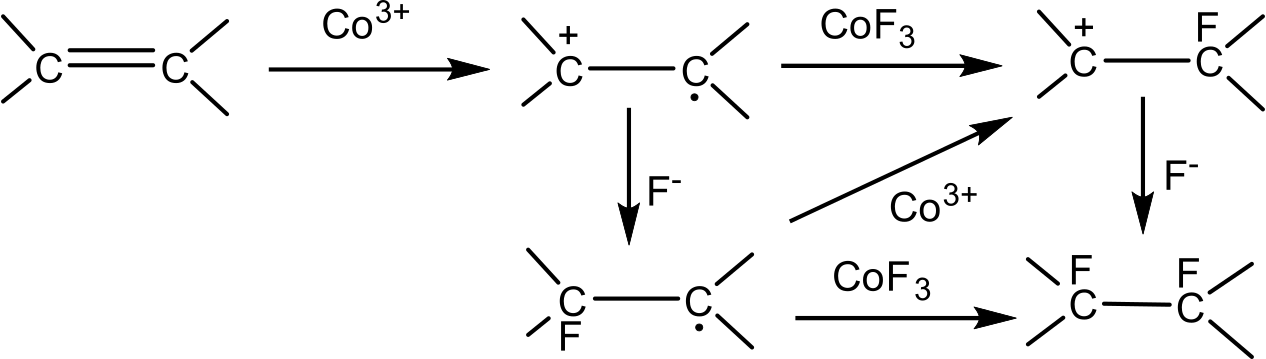
Scheme 1.
In 1976, the same authors published an article in which they presented the results of fluorination of ethane and ethylene with cobalt trifluoride and KCoF4 [4].
Based on the results obtained (including di-, tri-, and tetrafluoroethane isomers ratios), the following assumptions were put forward:
- The product ratios for pairs of isomers are not quite those expected for a random fluorination but are not far from it. If all the hydrogens of ethane were equally reactive at all stages of the fluorination, then the ratio of CH2F-CH2F to CH3-CHF2 in the product would be 3:2, that of CH3-CF3 to CH2F-CHF2 1: 9, and that of CHF2-CHF2 to CH2F-CF3, 2: 3. The actual ratios are not far from these values for both ethane and ethylene.
- Reaction probably does not proceed to any great extent via olefinic intermediates.
The following mechanism for ethylene fluorination was proposed (Scheme 2) [4].
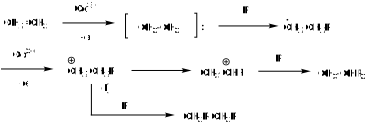
Scheme 2. Possible mechanism for ethylene fluorination [4].
The first three steps - oxidation to a cation-radical, quenching by F-, and further oxidation to a carbonium ion (in later publications, the modern term carbocation is used) were all in accord with cation-radical theory of fluorination with HVMFs proposed for benzene [2]. According to the authors, the rearrangement step could be possible based on the data that carbonium ions with α-fluorines are more stable than their β-fluoro-isomers [5].
A general reaction sequence for the fluorination of alkanes was also proposed (Scheme 3).
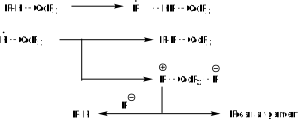
Scheme 3.
In 1977, when studying the fluorination process of 2-methylpropane with cobalt trifluoride, it was found that hydrogen replacement took place mainly according to certain rules [6].
Based on the isomer ratios in the intermediate polyfluoro-2-methylpropanes, it was established that predominant replacement of hydrogen for fluorine at the tertiary carbon atom occurs. The ratio of identified 2-difluoromethyl-1,1,1,3,3-pentafluoropropane (II) and 2-fluoromethyl-1,1,2,3-tetrafluoropropane (III) is given as an example (Scheme 4). If fluorination is random, the ratio of these compounds should be 1:1; it is, in fact about 1:8.
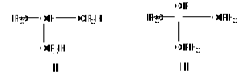
Scheme 4.
From this and other examples, the authors concluded that tertiary hydrogen replacement occurs about ten times more readily than would be expected on chance alone.
A scheme for the first steps of the fluorination process was proposed, which also explained the appearance of small amounts of n-polyfluorobutanes in the identified reaction products. By analogy with the processes of ethylene fluorination (See Scheme 2), the authors associated the appearance of n-polyfluorobutanes with the rearrangements of intermediate carbenium ions, which are due to the fact that the intermediate ion with fluorine at the tertiary carbon in the α-position is more stable than the isomer IV with fluorine in the β-position (Scheme 5). At the same time, migration of the CH3 group occurs. It has been proposed that migratory aptitude falls in the order CH3> CFH2> CF2H> CF3.
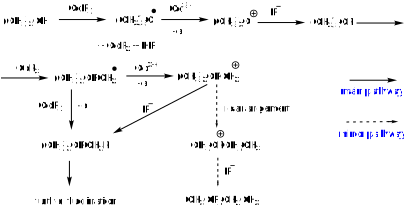
Scheme 5. Possible reaction steps in the fluorination of 2-methylpropane [6].
Further development of ideas about the mechanism of fluorination was made by J. Burdon and coworkers in the study of interaction of n-butane with cobalt trifluoride [7].
The fluorination of butane over cobalt trifluoride at 140÷230ºC had given a complex mixture of partially fluorinated compounds: 51 of these have been identified, comprising over 99% of the products. Most were n-polyfluorobutanes but l÷2% were polyfluoro-2-methylpropanes.
Based on the research results, the following conclusions were made:
- Secondary C-H was converted into C-F more easily then primary.
- The ease of replacement of a particular H was reduced by geminal and vicinal fluorines.
- Skeletal rearrangements butanes to 2-methylpropanes were insignificant (~1%).
The following steps of the process were proposed (Scheme 6):
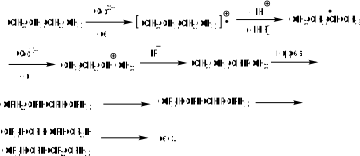
Scheme 6.
А computer program was written which could simulate a fluorination pattern in which hydrogens are replaced one at a time by fluorines without the intervention of alkenes (Scheme 7).

Scheme 7.
The model included five parameters:
- the reactivity ratio between a single H in a CH2 to a single H in a CH3:
- the amount by which the reactivity of an H in a CH2 (or CH3) is reduced (or increased) by introducing a geminal fluorine;
- the amount by which the reactivity of an H is reduced (or increased) by the introduction of a vicinal fluorine;
- and (5) two parameters to allow for the ease with which a compound might be released from the surface of the cobalt trifluoride and so appear in the products;
The best set of parameters was found, which gave a reasonable correspondence between the observed and calculated data on the distribution of most polyfluorobutane isomers.
At the same time, the computer model could not explain the presence of some compounds (CH3CF2CFHCH3, CFH2CF2CF2CH3, CF2HCF2CF2CH3, CF2HCF2CF2CFH2) that were identified in fluorination products.
To explain these results, a hypothesis was put forward those parallel processes with the formation of intermediate alkenes could have occurred in the early steps of fluorination. The authors estimated the contribution of such processes at 10-25%.
Two possible routes to obtain intermediate compounds with a double bond have been proposed:
- Possible abstraction of a proton from a carbocation (See Scheme 6) to form an alkene and subsequent addition of fluorine to the double bond (Scheme 8):
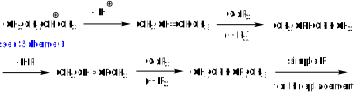
Scheme 8.
- Elimination of hydrogen fluoride (either thermally or by fluoride ion catalyzed elimination) followed by addition to the double bond of fluorine from cobalt trifluoride (Scheme 9).

Scheme 9.
According to the authors, HF elimination reactions could only occur at the earliest steps of fluorination, since highly fluorinated compounds do not release hydrogen fluoride under the process conditions.
Fluorination of other aliphatic saturated compounds showed that with an increase in the number of carbon atoms, there was an increase in products that resulted from extensive skeletal rearrangements. Such rearrangements were insignificant in the fluorination of methylpropane and butane [6,7], but, for example, in the fluorination of n-octane, no more than 50% of straight-chain perfluorooctane was obtained. The remaining products were branched-chain C8-isomers or C8-cyclic compounds.
In the article [9] an attempt was made to study the patterns of such skeletal rearrangements using C6 hydrocarbons as an example. For this purpose, hexane, 2-methylpentane, 3-methylpentane, 2,2-dimethylbutane, 2,3-dimethylbutane, methylcyclopentane and cyclohexane were fluorinated with CoF3 at high temperatures (for 2-methylpropane, the temperature was 360 °C). In all cases (excluding cyclohexane), a mixture of linear, branched, and cyclic C6-fluorocarbons was obtained. The degree of skeletal rearrangement varied from ca. 7% (methylcyclopentane) to 96% (2,2-dimethylbutane).
The following assumptions were made:
- The skeletal rearrangements during the fluorinations were not reaching equilibrium. Otherwise, open-chain compounds would yield the same mixture of products.
- The formation and rearrangements of carbocations are possible only early in a fluorination, because heavily fluorinated cations would not be expected to rearrange as there would be no suitable migrating group.
A possible process scheme (Scheme 10) and pathways for skeletal rearrangements of 2- and 3-methylpentanes, as well as 2,2- and 2,3-dimethylbutanes via relatively stable tertiary and secondary cations (Scheme 11) were proposed.
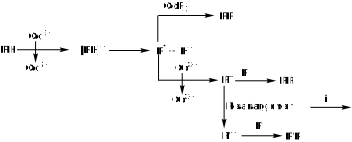
Scheme 10. Proposed route for fluorination of C6-hydrocarbons (i, Followed by further similar steps on RF and R’F) [9]
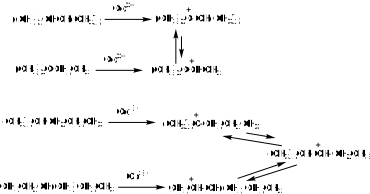
Scheme 11. Proposed mechanism for skeletal rearrangements of 2- and 3-methylpentanes, 2,2- and 2,3-dimethylbutanes [9].
However, the possible mechanism of rearrangements with the formation of linear compounds from compounds with a branched structure (for example, 2-methylpentane from 2,3-dimethylbutane or n-hexane from 2- or 3-methylpentanes) was left open for discussion.
The article also noted that a certain anomaly is the formation of perfluoromethylcyclopentane as overwhelmingly the major cyclization product, despite the fact that the six-membered ring is stable to fluorination.
For example, during the fluorination of 2-methylpentane and 3-methylpentane, the content of perfluoromethylcyclopentane in the reaction products was 25 and 21% (mol.) accordingly. The appearance of the 5-membered ring was explained by possible dehydrogenation reactions with the formation of double bonds (Scheme 12).
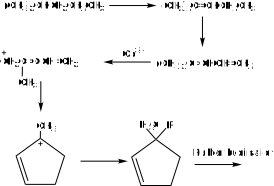
Scheme 12. Possible mechanism for the formation of 5-membered cyclic compounds [9].
As an additional example, the results of fluorination of 3-methylpent-2-ene were given. The product composition was much the same as that from 3-methylpentane. This did not directly confirm the possibility of desaturation, but, according to the authors, it showed that it cannot be ruled out.
Finally, the article also pointed out that skeletal rearrangements and cyclization at the hydrocarbon stage cannot be initiated catalytically by hydrogen fluoride, which is produced during the fluorination. At the same time, at the high temperatures, HF induced reactions certainly could not be dismissed lightly. As confirmation, the results of the fluorination of 2-methylpentane under mild conditions were presented, where approximately 10% of the starting hydrocarbon remained in the reaction products. The content of other C6 hydrocarbons was less than 1%.
The final article of J. Burdon et al. on the mechanisms of fluorination of aliphatic compounds was published in 1996. It reported the results of fluorination of propane and propylene over cobalt trifluoride (CoF3) and potassium tetrafluorocobaltate (KCoF4) [10].
The authors attempted to organize the reactions that can occur during the fluorination of aliphatic compounds using HVMFs. Several steps were identified.
I. The first step could be either electron-transfer from the substrate to a high oxidation metal ion, followed by H+ loss (reactions 1-2), or H-atom abstraction (reaction 3).
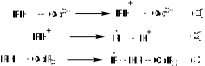
As a result, regardless of the reaction pathway, the radical R• is obtained. As a hypothesis, the authors suggested that reaction (1) prevails in the early steps of fluorination, and reaction (3) at the end and that with weak fluorinating agents, reaction (3) always predominates. As a justification for the hypothesis, data were presented on an increase in the value of the ionization potential of organic substrates with an increase in the degree of fluorination, which will complicate the reaction (1) (for example, C6H6 – 11,6 eV, C6F6 >14 eV [10]).
II. At the second step, the R• radical could either be oxidized by a metal ion (Co3+) to form a carbocation or the fluorine atom transfer could occur (reactions 4 and 5).
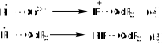
III. If reaction (4) occurs, the following typical reactions of carbocations are possible:
a) quenching with F- to obtain RF.
b) rearrangements, both skeletal and H-migrations.
As an example of skeletal rearrangements, the authors cited the previously mentioned article on the fluorination of C6 hydrocarbons [9]. It is assumed that skeletal rearrangements could only occur early in fluorination. Accordingly, reaction (5) occurs at high degrees of fluorination or when using weak HVMFs.
c) loss of H+.
IV. The possibility was considered that HVMFs could act as Lewis acids at further fluorination step and cause an RF compound to ionise (reaction 6).

It was noted that the possibility of this reaction would decrease as the degree of fluorination increased due to the decreased stability of the R+ cation. Moreover, such reactions should occur to a lesser extent with KCoF4, than with CoF3, because the latter would be expected to be a stronger Lewis acid.
In addition to the above reactions, an assumption was also made about the possibility of elimination of HF with the formation of intermediate olefins in reactions with weak HMVEs, but not for CoF3.
In analyzing the results of propane and propylene fluorination, the authors tried to answer a number of questions that arose due to the obtaining of some and the absence of other compounds in the reaction products:
- Why is 1-fluoropropane missing (<0.5%) from the fluorination products but 2-fluoropropane is present?
The formation of 2-fluoropropane exclusively was explained either by a possible rearrangement of the carbocation I (Scheme 13) before quenching with the fluoride anion, or by the formation of propylene under the reaction conditions followed by the addition of HF (Scheme 13).
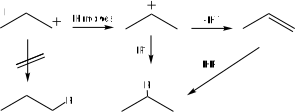
Scheme 13 [10].
- 1,1-Difluoropropane is present, but its 2,2-isomer is not, and how can the 1,1-compound be present when its apparent precursor, 1-fluoropropane, is missing?
The appearance of 1,1-difluoropropane was explained by a similar H-migration based on the assumption of the formation of propylene from propane at the initial step of the process (Scheme 13). By analogy with the cation-radical theory of fluorination of aromatic compounds [2], the oxidation of propylene could lead to the formation of a radical cation with further transformation through a series of steps into cation III (Scheme 14). The latter could rearrange into cation IV, which is more energetically favorable (due to the stabilizing effect of fluorine in the α-position in IV and the destabilizing effect of fluorine in the β-position in III, the difference can reach 60 kJ/mol). This pathway could lead to the formation of 1,1-difluoropropane without the formation of 1-fluoropropane as a precursor.
Scheme 14 also shows a possible pathway for the formation of two fluorinated alkenes (3-fluoroprop-1-ene in reactions with KCoF4 and 3,3-difluoroprop-1-ene in reactions with KCoF4 and CoF3) via the elimination of H+ from the cation radical. Both alkenes are mentioned in the article as reaction products.
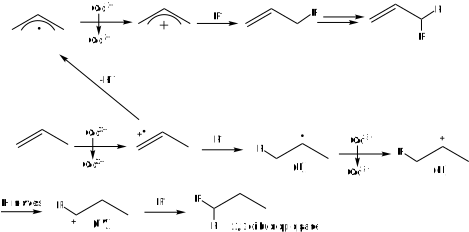
Scheme 14 [10].
To explain the absence of 2,2-difluoropropane, it was suggested that in the fluorination step of 2-fluoropropane, HMVEs acted only as Lewis acids according to reaction 6 to form propylene (Scheme 15).
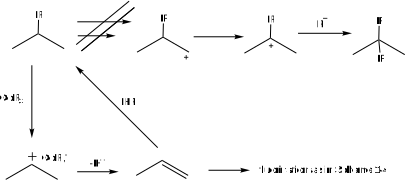
Scheme 15 [10].
Thus, according to the authors, propane fluorination should proceed through the initial formation of propylene, and therefore the composition of the products obtained during the fluorination of propane and propylene should be identical. The results obtained showed that the product compositions for both compounds were similar but not identical. This was explained by the fact that propylene was more reactive than propane under the process conditions.
- 1,3-Difluoropropane is missing, but its 1,2-isomer is present, but only in the KCoF4, fluorinations.
1,3-Difluoropropane was missing because its precursor, namely 1-fluoropropane (see I), was not present. 1,2-Difluoropropane could be formed from radical II (Scheme 14). This radical can either oxidise, as in Scheme 14, or it could be quenched by an F-atom to give 1,2-difluoropropane. In the case of weaker KCoF4, preferential quenching occurs with the formation of 1,2-difluoropropane, whereas in the case of strong cobalt trifluoride, oxidation occurs yielding 1,1-difluoropropane.
In conclusion, the authors proposed a general scheme for fluorination of saturated aliphatic compounds with HMVEs.
- Fluorination of saturated aliphatic substrates over transition metal fluorides begins by first forming alkenes.
- This is followed by competing steps involving carbocations (mainly at the beginning of the fluorination) and radical quenching by fluorine atom transfer (mainly later on).
- At the beginning of the fluorination, competing processes can occur: typical carbocation reactions, rearrangements, elimination, and quenching by the fluorine anion (F-).
- Carbocation formation can also occur through reactions of alkyl fluorides containing several fluorine atoms with HMVEs, which in this case act as Lewis acids.
- All these factors can vary greatly depending on the fluorinating agent. A strong fluorinating agent (CoF3) will be more likely to form carbocations than a weaker one (KCoF4).
Without questioning a significant part of the general conclusions of J. Burdon and coworkers, nevertheless, when studying the last article, a number of questions arose:
- The assumption that the process begins with the formation of alkenes cannot be applied to the fluorination of methane. Moreover, the fluorination of methane with cobalt trifluoride has been described in detail [12] and occurs without any significant visible differences from the fluorination of other aliphatic hydrocarbons: with increasing fluorination temperature, the content of more fluorinated compounds gradually increases (at 270ºC in the products there are only CHF3 and CF4 with a ratio of ≈2:1). Consequently, it is entirely possible to assume that the process of fluorination of other aliphatic compounds can also proceed, at least to some extent, without the formation of intermediate alkenes at the initial step.
- When considering the mechanism of propylene obtaining (Scheme 13), the possibility of elimination hydrogen fluoride from 2-fluoropropane (either thermally or by fluoride ion catalysed elimination) with followed addition of fluorine from HMVEs to double bond was not taken into account. At the same time, such possibility of hydrogen fluoride elimination was considered, for example, for butane fluorination in an earlier paper [7]. In this case, further rearrangements of carbocations I (Scheme 2) or III (Scheme 14) could explain the appearance of 1,1-difluoro derivatives both in the case of ethane fluorination and in the case of propane fluorination. A number of possible parameters that may influence such carbocation rearrangement processes will be discussed in the next part of the communication.
- The published results for the fluorination of propane and propylene did not contain highly fluorinated compounds, even at high process temperatures. For example, during propane fluorination with CoF3 at 300ºC, octafluoropropane was not detected in the reaction products, and the 1H-heptafluoropropane content was approximately 1% (mol). This does not correlate with other known results. For example, fluorination of butane at lower temperatures of 140÷230 ºC yielded in the appearance of 0.2% perfluorobutane and about 8% C4F9H isomers in the reaction mixture [7], fluorination of methylpropane at temperatures of 140÷200 ºC yielded perfluoromethylpropane and significant amounts of 1H-trifluoromethylhexafluoropropane [6], and fluorination of ethane at 165 ºC yielded of about 40% hexafluoroethane [4]. This discrepancy could be due to either errors in the identification of compounds in the reaction mixture (only the F19 NMR method was used) or to the fact that, since the fluorination products were collected in a cold trap at -40 ºC and the propane fed to the reactor was diluted with nitrogen, a number of low-boiling compounds (including C3F8 BP≈-37 ºC and C3F7H isomers BP ≈ -16 ºC) were not collected in the cold trap.
- The presence of fluorinated olefins in the reaction products of propane with cobalt trifluoride (3,3-difluoroprop-1-ene: 3% at 200 ºC and 2% at 300 ºC) differs from known fluorination results using CoF3. Thus, during the fluorination of butane at 140–230 ºC or methylpropane at 140–200 ºC, no unsaturated compounds were detected in the reaction products. The relatively inert hexafluoropropylene is almost completely fluorinated to octafluoropropane at 150 ºC. Moreover, fluorination with CoF3 at a temperature of about 100 ºC was proposed as an effective method for elimination of unsaturated impurities (CF2=CHCl, CF3-CF=CF2, CF3-CH=CH2) from 1,1,1,2-tetrafluoroethane [11].
References
- Kornilov V. V., Fluorination with high valency metal fluorides, cation-radical theory of fluorination of aromatic compounds, Fluorine notes, 2025, Iss. 5(162), http://en.notes.fluorine1.ru/public/2025/5_2025/article_1.html, DOI 10.17677/fn20714807.2025.05.01.
- Burdon J., Parsons I. W., Tatlow J. C., Fluorinations with High Valency Metal Fluorides and By the Electrochemical Method, Tetrahedron, 1972, Vol. 28, pp. 43-52, https://doi.org/10.1016/0040-4020(72)80053-X.
- Bawn C. E. H., Sharp, J. A., Reactions of the cobaltic ion. Part IV. The oxidation of olefins by cobaltic salts, Journal of the Chemical Society (Resumed), 1957, pp. 1854-1865, http://dx.doi.org/10.1039/JR9570001854.
- Burdon J.,Knights J., Parsons I, Tatlow J. The fluorination of ethane and ethene over potassium tetrafluoride cobaltate (III) and cobalt trifluoride, Tetrahedron, 1976, V.32, p.1041-1043, https://doi.org/10.1016/S0040-4020(01)83232-4.
- Clark D. T., Lilley D. M. J., Barriers to internal rotation in carbonium ions: a non-empirical LCAO–MO–SCF investigation of 1- and 2-fluoroethyl cations, J. Chem. Soc. D, 1970, 603-604, https://doi.org/10.1039/C29700000603.
- Burdon J., Huckerby T. and Stephens R. The Fluorination of 2-Methylpropane over Cobalt Trifluoride, Journal of Fluorine Chemistry, 1977, V.10, Iss. 6, pp. 523- 540, https://doi.org/10.1016/S0022-1139(00)82432-X.
- James Burdon, Saleh T. Ezmirly, Thomas N. Huckerby. The fluorination of Butane over cobalt trifluoride. // Journal of Fluorine Chemistry, 1988 Vol. 40; pp. 283-318.
- Burdon J., Rearrangements during the exhaustive fluorination of aliphatic hydrocarbons, Journal of Fluorine Chemistry, 1987, V.35, Iss. 1, pp. 15-16, https://doi.org/10.1016/0022-1139(87)95010-X.
- Burdon J., Creasey J. C., Proctor L. D., Plevey R. G., Yeoman J. R. N., Skeletal rearrangements during the fluorination of C6-hydrocarbons over cobalt (III) trifluoride, J. Chem. Soc., Perkin Trans. 2, 1991, Iss. 4, pp. 445-447, DOI: 10.1039/P29910000445.
- Burdon J., Garnier L, Powell R. L., Fluorination of propane and propene over cobalt (III) trifluoride and potassium tetrafluorocobaltate (III), J. Chem. Soc., Perkin Trans. 2, 1996, Iss. 4., pp. 625-631, http://dx.doi.org/10.1039/P29960000625.
- RU Patent # 2009116, Method for purifying 1,1,1,2-tetrafluoroethane, 1994.
- Asovich V.S., Kornilov V.V., Kostajev R.A., Maximov B.N., Fluorination of methane and its fluoroderivarives by cobalt trifluoride, Zhurnal Prikladnoi Khimii (Russian Journal of Applied Chemistry), Vol. 67, Iss. 1, 1994, p. 103-107.
ARTICLE INFO
Received 18 October 2025
Accepted 10 December 2025
Available
online December 2025
Recommended for publication by PhD M.A. Manaenkova
eLIBRARY Document Number (EDN) DSONXI

Fluorine Notes, 2025, 163, 1-2